
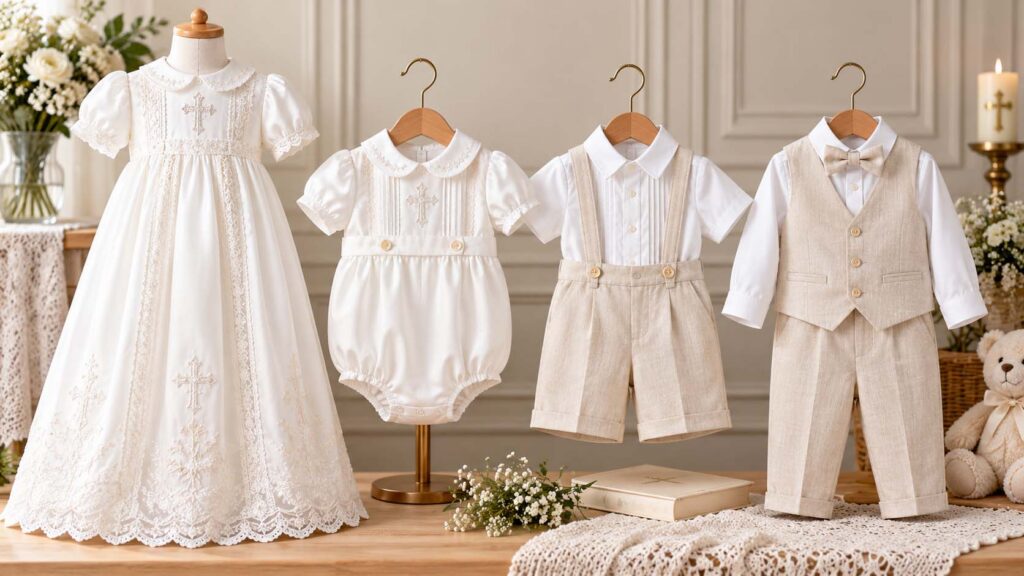
Choosing a baby boy christening outfit often starts with appearance, but a well-made style should offer more than a formal look. Fabric quality, fit, lining, construction, and small finishing details all affect how the garment looks and feels when worn.
From our experience developing children’s formalwear, some of the biggest quality differences are difficult to see in product photos. Fabric weight, neckline construction, inner seams, lining, and trim attachment can make two similar-looking outfits feel very different in person.
Whether you are comparing a traditional gown, a romper, or a tailored set, knowing what to inspect makes it easier to recognize a well-made garment.
What Makes a Baby Boy Christening Outfit Well-Made?
A well-made christening outfit should have a balanced silhouette, suitable fabric, comfortable lining, clean seams, and carefully secured details. These elements work together, so an attractive design alone does not necessarily indicate good construction.
When we review samples, we usually look first at the silhouette, fabric hand feel, seams, lining, and the amount of fabric used. Good fabric with sufficient material tends to create a fuller and more refined shape, while thin fabric or reduced fabric usage can make a similar design look noticeably flatter.
The inside deserves the same attention as the outside. Turning the garment over to inspect the lining, seams, closures, and finishing often reveals details that cannot be judged from embroidery or decoration alone.
Traditional and Modern Baby Boy Christening Outfit Styles
A christening outfit for a baby boy does not have to follow one specific silhouette. Traditional long gowns are still used, while rompers and tailored sets give families and retailers more contemporary options.
Because christening practices can vary between churches and families, clothing preferences are not always identical. The Church of England’s christening guidance provides useful background on the ceremony itself. If a family is unsure about specific clothing expectations, it is best to check with the church where the christening will take place.
If you want more background on the garment itself, our guide to what a christening gown is explains its main features and purpose.
| Style | Typical Features | Practical Considerations |
|---|---|---|
| Traditional Christening Gown | Long silhouette, white or ivory fabric, embroidery or subtle ceremonial details | Classic appearance and often chosen for traditional or heirloom use |
| Formal Romper | One-piece construction, collar, piping, pleats or embroidery | Compact and practical for younger babies |
| Two-Piece Set | Shirt with shorts or trousers | Easier to coordinate and suitable for a more modern formal look |
| Three-Piece Set | Shirt, waistcoat and trousers or shorts | More tailored appearance, but fit and fabric softness need extra attention |
Whatever the style, comfort and construction should remain part of the decision. A baby suit, for example, should not simply copy adult tailoring in miniature; stiff collars, restrictive waistbands, or unnecessarily heavy layers can make a smart-looking outfit uncomfortable.
Best Fabrics for a Baby Boy Christening Outfit
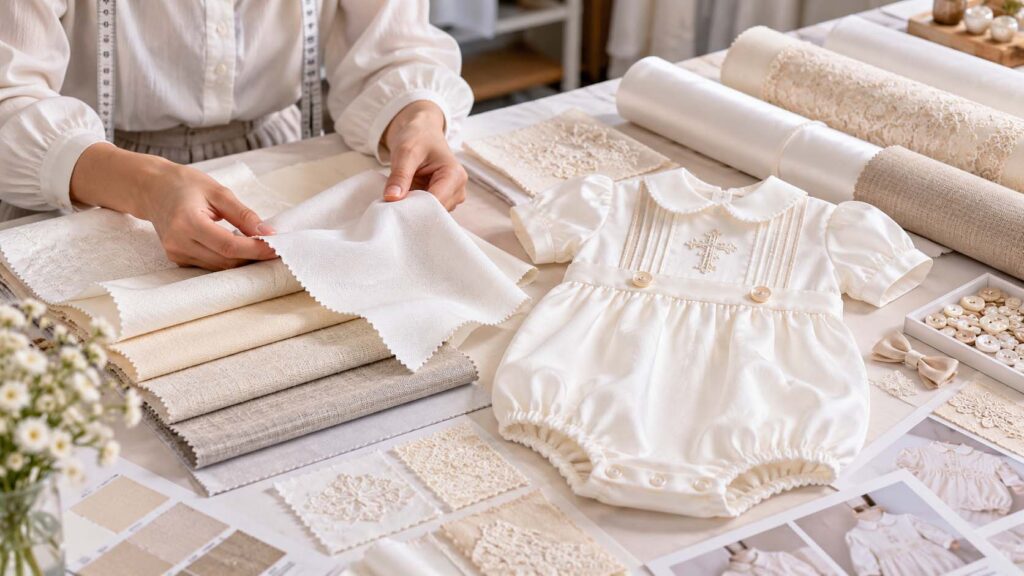
Fabric affects more than softness. It influences how a collar sits, how trousers fall, how a romper holds its shape, and whether the finished garment looks refined when viewed from different angles.
For that reason, select fabric alongside the pattern and intended silhouette. A material that works well for a soft romper may not provide enough structure for a tailored formal set.
Common Fabrics for Baby Boy Christening Outfits
Cotton is often useful where softness and breathability are priorities, particularly for linings and areas close to the skin. Cotton blends can add structure, while linen blends can create a crisp, natural look suitable for warmer conditions.
Satin and smooth woven fabrics can give a more ceremonial finish, but appearance should not be the only consideration. The hand feel, weight, lining, and construction all influence whether a material works well in babywear.
There is no single fabric that works best for every baby boy baptism outfit. Season, silhouette, fabric weight, lining, and the desired level of formality all play a part. For buyers sourcing babywear, textile testing can also be part of the material review. The OEKO-TEX STANDARD 100 certification indicates that a textile article has been tested for harmful substances, with requirements that take the intended skin contact into account.
Fabric Weight, Drape, and Fabric Usage
Two outfits made from similar patterns can look surprisingly different once finished. Fabric weight and drape affect how the garment falls, while the amount of material used influences fullness, proportion, and the overall silhouette.
We see this regularly during sample development. When a design requires volume or a clean formal shape, reducing fabric too much can change the appearance of the entire garment, even when the sewing itself is technically correct.
For buyers comparing materials for different children’s clothing categories, our guide to cotton vs. polyester kidswear explains some of the practical differences between commonly used fabrics.
Comfort and Fit in a Baby Boy Christening Outfit
Christening clothes are occasionwear, but they are still made for babies. An outfit may be worn through a church service, photographs, travel, and a family gathering, so comfort should be considered from the start.
A formal appearance and comfortable construction do not have to compete with each other. Good pattern development should allow the garment to look neat while still accommodating normal infant movement.
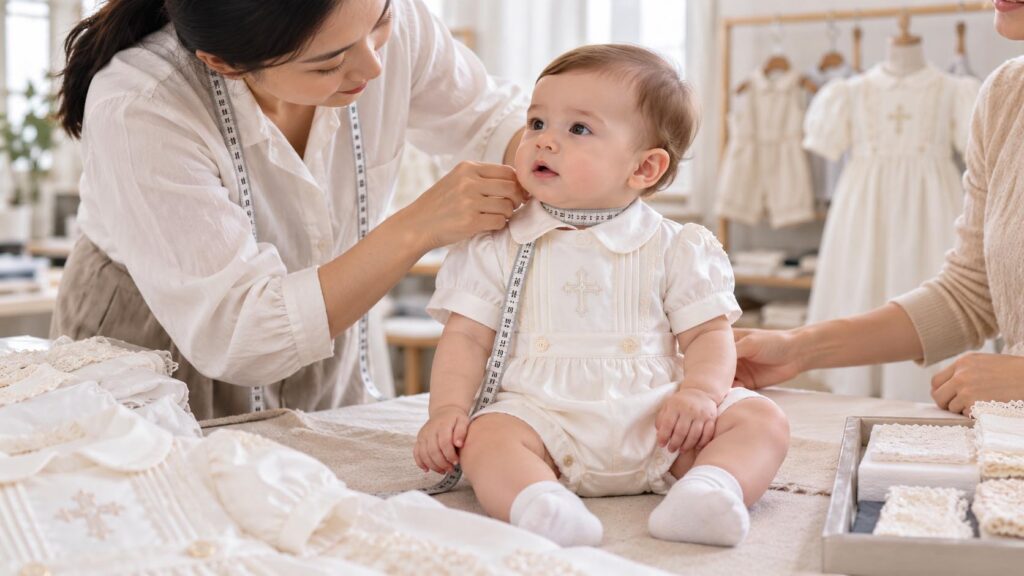
Check the Neckline and Overall Fit
The neckline is one area we pay particular attention to when reviewing samples. A structured collar may look neat in photographs, but if the neck opening is too tight, it can quickly become uncomfortable for the baby.
The shoulders and chest should also allow natural movement. For rompers and one-piece styles, enough body and crotch room is needed to accommodate a diaper without making the garment look oversized.
A good pattern balances both needs. The goal is not to make the outfit loose, but to maintain a clean silhouette without creating unnecessary pressure around sensitive areas.
Look at the Lining, Not Just the Outer Fabric
The outer fabric creates the first impression, but the lining is often what the baby actually feels. This becomes particularly important when structured or decorative outer materials are used.
From our sample-development experience, soft cotton lining can make a noticeable difference around areas that stay close to the skin. A beautiful outer fabric cannot compensate for an interior that feels rough or uncomfortable.
When checking an outfit, feel inside the neckline, bodice, armholes, and other contact areas. These less visible details can be a useful indication of whether comfort was considered during product development.
Construction Details That Reveal Christening Outfit Quality
A useful way to judge construction is simply to turn the garment inside out. The internal finish often tells you more about manufacturing quality than the amount of decoration on the front.
Look for consistent stitching, controlled seams, clean edges, and an interior that does not feel unnecessarily bulky. Pay particular attention to collars, cuffs, armholes, and closures, where several layers of fabric may meet.
The lining should also sit naturally with the outer layer. If the two layers pull against each other, the finished garment may twist or lose its intended shape.
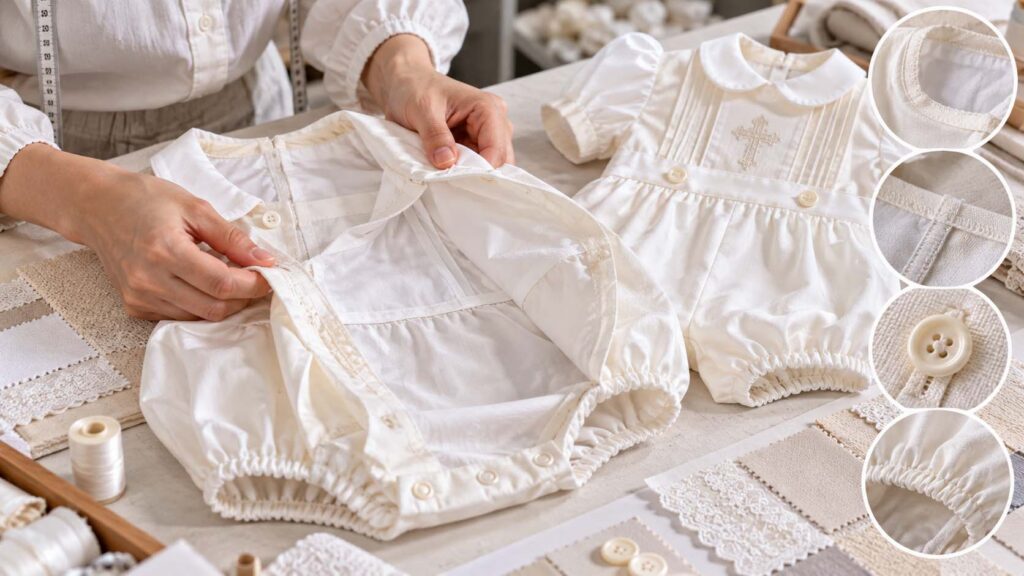
Buttons, Closures, and Decorative Details
Buttons, bows, embroidery, appliqués, and other trims can give a simple christening outfit its character. More decoration, however, does not automatically mean a better-made garment.
What matters is how those details have been applied. They should sit neatly, remain secure, and avoid creating unnecessary roughness or bulk in areas that may come into contact with the baby.
Fit and Sizing for Baby Boy Christening Outfits
Even a beautifully constructed outfit will disappoint if its proportions are wrong. Babywear sizing needs to account for diapers, movement, and the changing body proportions of infants at different ages.
For rompers, body length deserves particular attention. If the torso is too short, adding a diaper can cause the garment to pull at both the shoulders and crotch, even when the chest measurement appears correct.
Closures matter too. A well-designed infant outfit should be reasonably easy to put on and remove, while practical access for diaper changes can make one-piece styles easier to use without affecting their formal appearance.
Check Size Grading Across the Full Range
For retailers and brands, checking only one attractive sample size can create problems later. The proportions need to remain balanced as the pattern moves through the intended size range.
A 3–6M sample may fit well while larger sizes develop issues with collar proportion, body width, trouser length, or overall balance. Reviewing more than one size before bulk production can help identify these problems earlier.
For more detail on infant sizing and garment proportions, see our Baby Romper Size Guide.
Safety Details to Check in Baby Christening Outfits
Baby formalwear often contains more decorative components than everyday clothing. Buttons, bows, flowers, appliqués, and other small trims therefore deserve careful attention during both development and quality inspection.
The way these components are attached matters as much as their appearance. The U.S. Consumer Product Safety Commission provides guidance and safety resources for children’s products, which can be useful for businesses supplying children’s goods to the U.S. market.
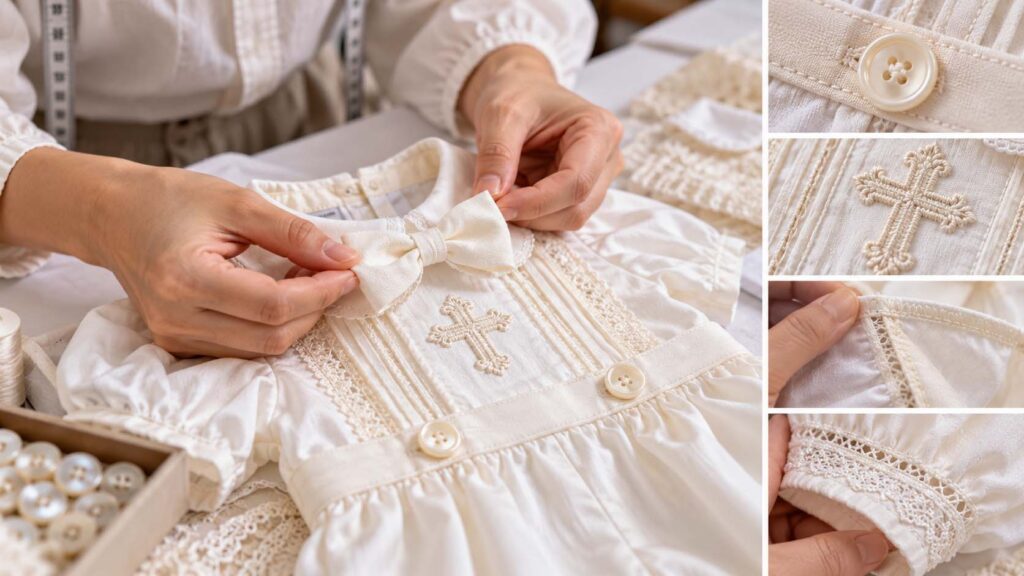
Check How Trims and Decorations Are Attached
In our production work, we avoid certain attachment methods for some baby garments. Where a decorative component could loosen or come into contact with the baby, we prefer secure sewing methods where appropriate rather than relying on pins or simple glue attachment.
This approach also tends to produce a cleaner finished garment. A trim considered during construction usually looks more integrated than one simply added after the main garment has been completed.
When reviewing a sample, check more than the front appearance. Examine how buttons, bows, flowers, and similar details are actually secured.
What Retailers and Brands Should Check Before Bulk Production
For a parent buying one garment, the finished outfit is usually the main concern. For a retailer, wholesaler, importer, or brand, there is an additional question: can the approved quality be repeated across the full order?
A strong development sample is only the starting point. Bulk production introduces additional considerations involving sizing, fabric lots, color consistency, trims, measurements, and workmanship.
Sample Quality vs. Bulk Production Consistency
Before production, buyers and suppliers should agree on the important details that define the approved product. A practical pre-production review can focus on:
- Fabric and color: Confirm the approved outer fabric, lining, color reference, and major trims.
- Measurements and grading: Review key garment measurements and how they change across the size range.
- Construction: Keep the approved sample as the reference for seams, closures, trim placement, and workmanship.
- Changes: Confirm substitutions or modifications before alternative materials enter bulk production.
Clear approval at this stage can prevent small differences from becoming much larger issues once hundreds of garments have been produced.
For buyers deciding between immediate inventory and product development, our guide to ready stock vs. custom kidswear explains how the two sourcing approaches differ.
Watch for Fabric Color Differences Between Batches
Color variation is one issue buyers can easily overlook. Different fabric or dye lots may show slight shade differences even when they are intended to match the same approved color.
From our production experience, when a noticeable difference exists, it is better to show it to the buyer and confirm the acceptable range before continuing. Waiting until all finished garments are completed makes the issue much harder to resolve.
This deserves particular attention with white, ivory, cream, and other closely related ceremonial shades. Small differences can become more visible when several garments are displayed together in a boutique or collection.
Traditional Details That Add Value to Christening Outfits
A baby christening outfit does not need heavy embellishment to feel special. Fine embroidery, covered buttons, subtle piping, monogramming, or carefully placed pleats can create a distinctive look without overwhelming the garment.
Matching accessories such as a bonnet or blanket may complement styles intended to be preserved as keepsakes. For private-label collections, carefully selected details can also help create a recognizable product identity.
The strongest designs usually use decoration to support good fabric and construction rather than distract from weak fundamentals.
How to Evaluate a Baby Boy Christening Outfit Before Ordering
Whether you are reviewing one sample or preparing a larger order, it helps to follow the same inspection process each time. This makes it easier to compare products objectively instead of choosing only by first impression.
| What to Check | What to Look For | Why It Matters |
|---|---|---|
| Overall Shape | Balanced collar, sleeves, body length and proportions | Shows whether the pattern and fabric work together |
| Fabric & Lining | Soft hand feel, suitable weight, drape, and comfortable lining | Affects appearance and wearing comfort |
| Inside Construction | Clean seams, controlled stitching and neat lining | Reveals workmanship that photos may not show |
| Fit | Comfortable neckline, shoulders, chest and crotch | Helps maintain movement without losing the formal shape |
| Trims & Closures | Secure buttons, bows, snaps and decorations | Important for durability and babywear construction |
| Bulk Consistency | Size grading, measurements, color and workmanship | Helps the approved sample translate into production |
This process is particularly useful when sourcing online. Product photographs can communicate style, but they rarely show everything that matters about construction.
From Christening Outfit Samples to Consistent Bulk Production
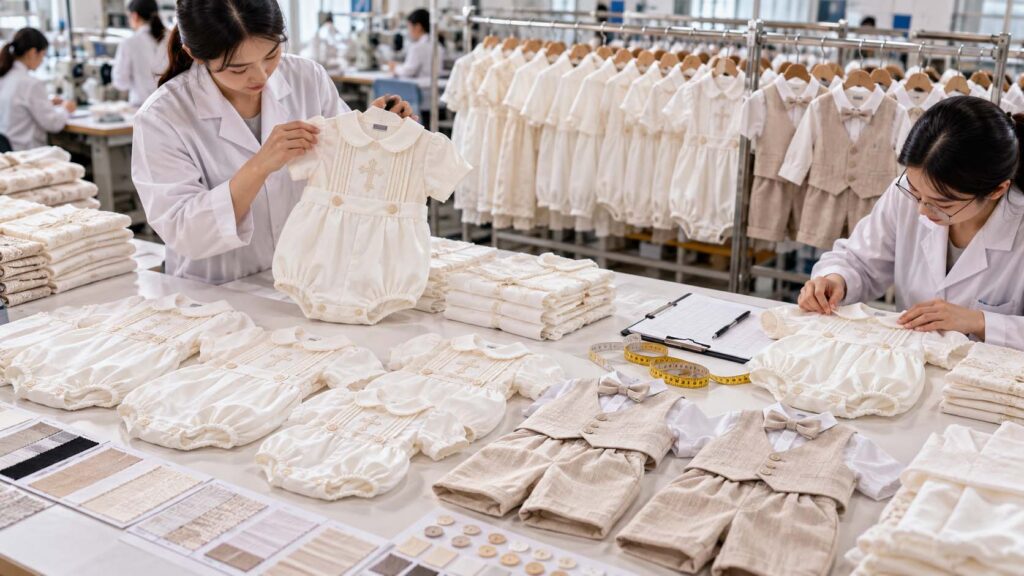
For B2B buyers, a well-made baby boy christening outfit should not be limited to one carefully prepared sample. Fabric, fit, color, trims, and workmanship need to remain consistent when the style moves into larger production.
This starts with fabric selection and pattern development, followed by sample fitting, size grading, trim confirmation, pre-production approval, bulk production, and quality inspection. If you are developing your own collection, our OEM and ODM children’s clothing services explain the development process in more detail.
At Outong Fashion, we develop children’s formalwear and babywear for international B2B buyers. Our OEM/ODM and private-label services support product development from sampling through bulk production, with fabrics, colors, sizing, construction, and design details adjusted for different markets.
Conclusion: Quality Is in the Details
There is no single design that defines the perfect baby boy christening outfit. Traditional gowns, formal rompers, two-piece outfits, and three-piece sets can all work well when the fabric, pattern, lining, construction, and fit are appropriate for the baby and the occasion.
When comparing styles, look beyond decoration and product photos. Fabric hand feel, sufficient material, comfortable lining, clean seams, secure details, and balanced proportions often reveal much more about the true quality of the garment.
For retailers and brands, quality also needs to remain consistent beyond the approved sample. Checking size grading, fabric batches, color, trims, and workmanship before bulk production can help prevent avoidable problems later.
Looking for Baby Boy Christening Outfits for Your Collection?

If you are a children’s boutique, retailer, wholesaler, importer, or brand sourcing baby christening wear, Outong Fashion supports wholesale, OEM/ODM, and private-label children’s clothing development. We can work with buyers on samples, fabrics, colors, sizing, construction details, and bulk production for different markets.
Contact Outong Fashion to request our babywear and formalwear catalog, arrange sample development, or discuss a baby boy christening outfit collection for your business.
FAQs
Q1: What should a baby boy wear for a christening?
A baby boy may wear a traditional christening gown, formal romper, two-piece outfit, or small three-piece set. The best choice depends on family tradition, the baby’s age, the climate, and any expectations from the church or ceremony.
Whatever the style, the outfit should allow room to move and use materials that feel comfortable against the baby’s skin.
Q2: Can a baby boy wear a romper for a christening?
Yes. A formal romper can be a practical modern alternative to a traditional long christening gown, particularly for younger babies.
Look for a style with comfortable fabric, appropriate room through the body and crotch, practical closures, and restrained formal details such as embroidery, piping, or a structured collar.
Q3: What color should a baby boy christening outfit be?
White and ivory are traditional choices for christening clothing, while cream, pale blue, beige, and other subtle tones may also be used depending on family preference and the ceremony.
Because customs can differ between churches and denominations, families should confirm any specific dress expectations with the church where the christening will take place.
Q4: What is the best fabric for a baby boy christening outfit?
The best choice depends on the season, garment structure, and desired appearance. Cotton and cotton blends can provide softness and breathability, while linen blends, satin, and other woven fabrics create different formal effects.
The outer material should not be considered alone. Lining, fabric weight, drape, and the areas that directly contact the baby’s skin are equally important.
Q5: How should a baby boy christening outfit fit?
A christening outfit should look neat without restricting movement. There should be comfortable room around the neckline, shoulders, chest, waist, and crotch.
For infant rompers and one-piece outfits, allow enough body length for a diaper. An outfit that appears correct on a hanger may feel considerably tighter once worn.
Q6: What should retailers check when sourcing baby boy christening outfits?
Retailers should look beyond design and price when reviewing samples. Fabric quality, lining, internal construction, size grading, measurements, trim attachment, color consistency, and bulk-production workmanship can all affect the final product.
For larger orders, it is useful to establish an approved sample and confirm important materials, measurements, and workmanship requirements before production begins.