Sourcing a flower girl gown for resale requires more than choosing a beautiful design. Retailers need to consider style, fabric, construction, sizing, color, price, production consistency, and whether the supplier can reproduce the approved quality in bulk.
This guide is designed for children’s boutiques, bridal stores, online retailers, wholesalers, importers, and private-label buyers. It focuses on practical sourcing decisions that can help buyers select flower girl dresses and girls’ formalwear with stronger retail and repeat-order potential.
1. Choose Flower Girl Gown Styles with Repeat-Order Potential
A good retail collection should balance visual appeal with commercial practicality. Instead of selecting only highly decorated gowns, buyers should consider whether a style fits their target customers, price range, selling occasions, and reorder potential.
What We See in Repeat Orders
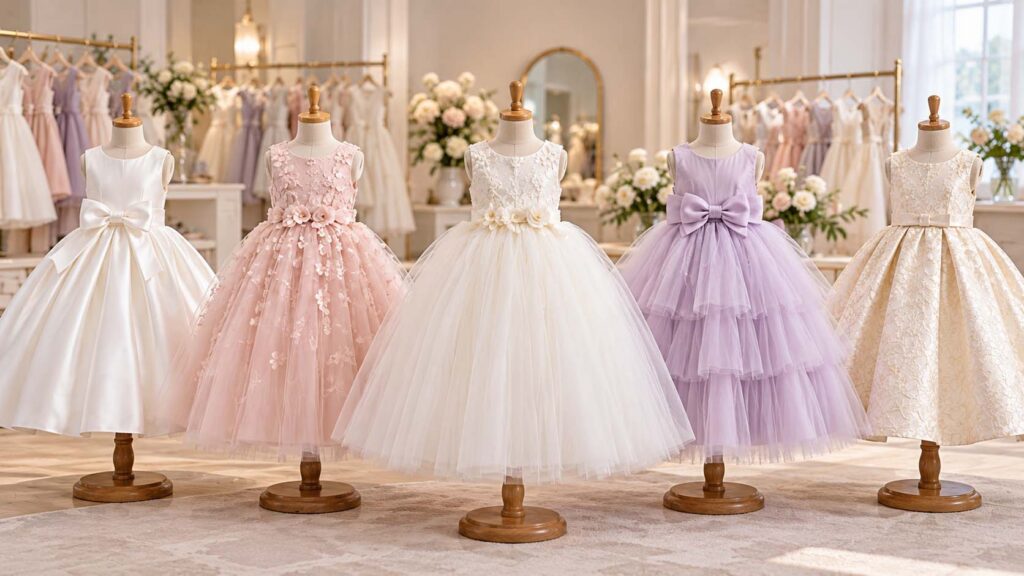
From our experience with wholesale orders, simple silhouettes, tulle styles, floral details, bow decorations, and jacquard designs are among the flower girl gowns that buyers frequently reorder. These styles can also work across weddings, parties, communions, and other formal occasions.
This does not mean the same designs will perform equally well in every market. Retailers should combine supplier experience with their own sales history, customer preferences, target price points, and local demand when planning a girls’ dress collection.
2. Check the Fabric Before Comparing Flower Girl Gowns

Fabric affects far more than the appearance of a flower girl dress. It influences comfort, skirt structure, drape, durability, perceived quality, and ultimately the wholesale price of the finished garment.
Tulle, satin, lace, jacquard, and lining fabrics can vary considerably in weight, softness, transparency, stiffness, and sheen. Buyers developing custom collections should request physical fabric swatches whenever possible rather than making decisions from photos alone.
For children’s apparel, fabric selection should also consider applicable safety and chemical requirements in the destination market. Buyers sourcing internationally can refer to OEKO-TEX STANDARD 100 for information about textile testing for harmful substances.
Match the Fabric to the Intended Gown Structure
A soft tulle can create a light, flowing skirt, while a more structured tulle may be needed for a fuller silhouette. Satin weight also affects how the bodice and skirt drape, while the lining should provide enough coverage without feeling unnecessarily stiff.
Retailers should therefore evaluate the complete fabric combination rather than judging one material separately. Two gowns that appear similar in photographs can feel and perform very differently when different fabric qualities are used.
3. Inspect Construction, Not Just Decorative Details
Flowers, bows, lace, embroidery, beads, and appliqués can make a flower girl gown attractive, but decoration alone does not indicate good garment quality. The underlying garment construction is just as important when evaluating a sample for retail.
Buyers should inspect stitching, seams, hems, zippers, lining, waist construction, neckline finishing, and the attachment of decorative elements. Loose threads, puckering, uneven hems, weak closures, or poorly secured decorations can become larger problems across a bulk order.
For buyers selling children’s clothing in the United States, product development should also take applicable U.S. safety requirements into account. The U.S. Consumer Product Safety Commission provides official guidance for businesses manufacturing and importing consumer products, including requirements relevant to children’s products.
4. Check Fabric Consumption, Silhouette, and Skirt Fullness
One sourcing detail that is easy to overlook is how much material is actually used in the gown. Fabric consumption can directly affect skirt volume, drape, silhouette, appearance, and cost, particularly with layered tulle flower girl dresses.
A Practical Lesson from Sample Evaluation
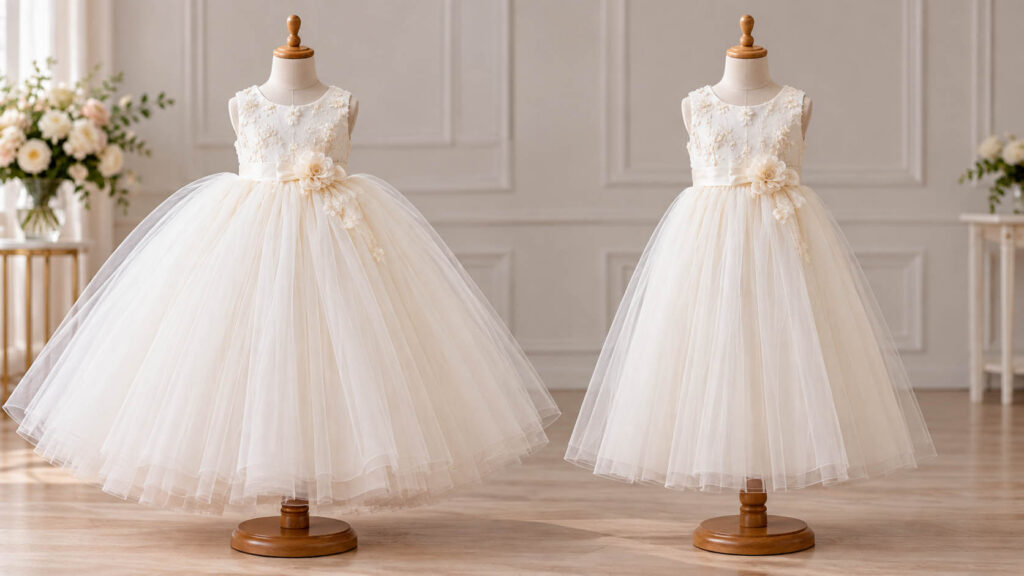
In our sample evaluations, workmanship and material consumption are two areas we pay close attention to. When insufficient tulle or fewer skirt layers are used, the finished gown may look noticeably less full even though the basic design remains the same.
We therefore look at workmanship, fabric consumption, silhouette, skirt fullness, measurements, and color together before approving a style. For buyers, this is one reason a physical sample provides much more useful information than supplier photos alone.
5. Confirm Size Range, Measurements, and Size Grading
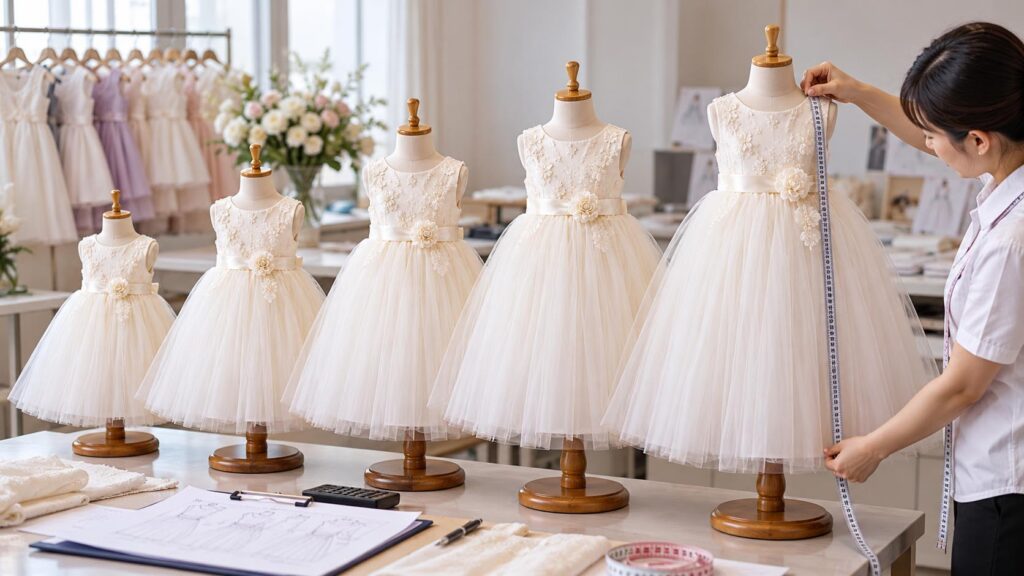
Approving one sample size does not guarantee that every size will have the same proportions. Retailers should review a detailed flower girl dress size guide and understand how chest, waist, shoulder, armhole, and dress length change across the size range.
Size grading is especially important for flower girl gowns because skirt length, waist placement, and bodice proportions can affect the overall appearance. Buyers should also confirm acceptable measurement tolerances before bulk production begins.
Build the Size Range Around Your Customers
The right size assortment depends on the customers a retailer actually serves. Historical sales data, customer age ranges, regional sizing expectations, and the type of store should all influence how quantities are distributed across sizes.
For important styles or larger orders, checking more than one sample size can also help reveal grading problems before production. This is particularly useful when a collection covers a wide range of children’s sizes.
6. Approve Colors and Material Matching Before Production
White, off-white, ivory, champagne, and blush may sound straightforward, but the finished shades can differ noticeably between satin, tulle, lace, lining, flowers, and bows. Screens and photography can create additional differences in how these colors appear.
Buyers should approve physical color references whenever color matching is important. Looking at all materials together is especially useful for ivory and champagne gowns, where a small difference between the bodice, skirt, and decoration can affect the finished appearance.
For repeat orders, retailers should also ask how the supplier handles color consistency between production batches. Keeping an approved sample or color reference can make later comparisons easier.
7. Approve a Sample Before Placing a Bulk Order
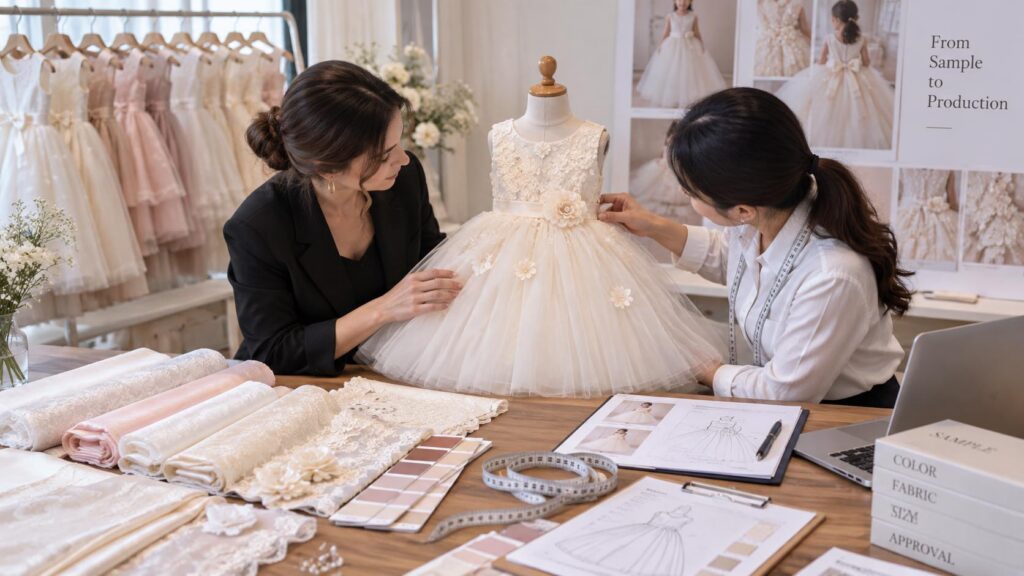
A physical sample allows buyers to evaluate details that are difficult to judge from catalog images. It provides an opportunity to check whether the actual gown matches expectations for fabric, structure, workmanship, sizing, color, and overall appearance.
Before approving a flower girl gown for bulk production, check:
- Overall silhouette, skirt fullness, fabric, lining, measurements, and color matching.
- Stitching, zippers, closures, hems, flowers, bows, embroidery, beads, and other decorative details.
- Whether the finished sample matches the agreed design, construction, measurements, and product specifications.
Any requested changes should be documented clearly before production starts. For custom designs, a revised or pre-production sample may be appropriate when substantial changes are made after the first sample. Buyers can also learn more about our manufacturing and product development capabilities before starting a custom project.
8. Compare MOQ and Wholesale Price Together
The lowest quotation does not necessarily represent the best sourcing value. Flower girl gown prices can change according to fabric quality, material consumption, skirt construction, embellishments, workmanship, order quantity, packaging, and customization requirements.
Retailers should compare quotations using similar specifications. A gown using more tulle, better lining, stronger construction, or more detailed handwork should not be compared directly with a visually similar product made to a different standard.
Ready Stock vs Custom Flower Girl Gowns
| Sourcing Factor | Ready Stock | Custom Production |
|---|---|---|
| MOQ | More suitable for smaller test orders | Usually requires a higher MOQ |
| Product Development | Existing styles | Buyer-specific development possible |
| Fabrics & Colors | Based mainly on available options | Greater control over fabrics and colors |
| Labels & Details | Limited customization | Better suited to private-label requirements |
| Lead Time | Faster when stock is available | Requires sampling and production time |
| Best For | Testing styles and smaller orders | Established collections and brand development |
Ready stock can be useful when retailers want to test a category with less inventory commitment, while custom production provides greater control over product specifications. Our guide to ready stock vs custom kidswear explains the differences in more detail.
The right choice depends on order volume, target price, brand positioning, and how much product differentiation is required. MOQ should therefore be evaluated together with customization requirements and total sourcing cost.
9. Confirm Production Lead Time and Reorder Capability
Timing matters in wedding and occasionwear because retailers often buy around specific selling seasons. Buyers should distinguish between sample development time and bulk production lead time and leave enough room for revisions, production, quality inspection, and shipping.
Reorder capability is equally important when a style performs well. A supplier should be able to explain whether the same fabric, trims, decorations, colors, measurements, and construction can be reproduced for future orders.
Before planning repeat orders, confirm:
- Whether you can source the same fabrics, trims, colors, and decorative materials again.
- Whether size specifications and construction standards can remain consistent.
- How production lead time may differ between an initial order and a repeat order.
For broader textile sourcing and apparel industry information, professional buyers can also refer to Fibre2Fashion for information about textile materials, apparel manufacturing, sourcing, and global industry developments.
10. Evaluate the Supplier’s QC Standards Before Ordering
Good product photography and a competitive quotation are not enough to evaluate a long-term flower girl dress supplier. Retailers should understand how quality is controlled during production and what is inspected before the finished goods are shipped.
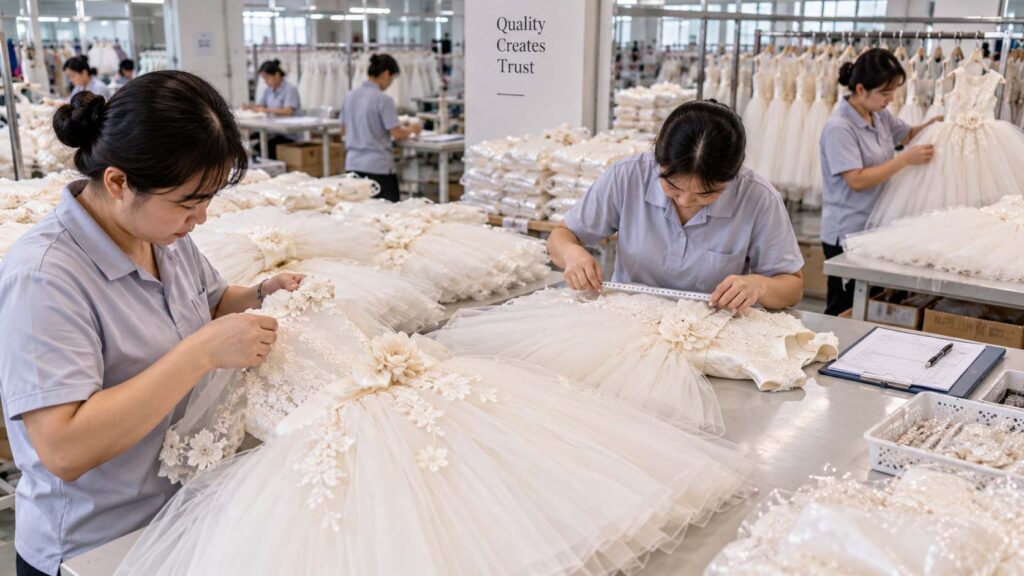
Three Factors We Watch in Bulk Production
From our production experience, lead time, QC requirements, and price are three factors that need to be considered together. A quotation only makes sense when the buyer understands the materials, workmanship, construction, and quality standard included in that price.
Quality expectations should also be agreed before production begins. Measurements, workmanship, colors, material consumption, decorations, and finished appearance can then be checked against an approved standard rather than discussed only after the order is completed.
A realistic production schedule is equally important. Compressing production time too aggressively can create unnecessary pressure on manufacturing and inspection, so retailers should agree on achievable delivery dates with their supplier from the beginning.
What to Confirm Before Placing a Flower Girl Gown Order
Before confirming an order, retailers should make sure the product and commercial requirements are clearly documented. This reduces misunderstandings during production and provides a clearer reference when the finished goods are inspected.
Confirm the following before production:
- Approved style, colors, fabrics, construction, size range, measurements, and final sample.
- MOQ, final price, customization, packaging, production lead time, and delivery requirements.
- QC standards, inspection expectations, and whether successful styles can be reordered consistently.
A clear pre-production record is particularly valuable for custom and private-label orders. Buyers unfamiliar with our production background can also review our company and manufacturing capabilities before discussing a new collection.
FAQ
Q1. What should retailers check when sourcing flower girl gowns?
Retailers should evaluate style, fabric, construction, material consumption, sizing, color, samples, MOQ, price, production timing, and quality control. These factors should be considered together rather than judging a gown only by its appearance.
Q2.Should I order a sample before buying flower girl dresses in bulk?
Yes. A physical sample makes it easier to evaluate fabric, workmanship, skirt fullness, measurements, color matching, closures, decoration, and overall construction before committing to a larger production order.
Q3.What fabrics are commonly used for flower girl gowns?
Tulle, satin, lace, and jacquard are commonly used, often with separate lining fabrics for comfort and coverage. The appropriate combination depends on the desired silhouette, season, target price, and design.
Q4.How do retailers choose the right flower girl dress size range?
Start with a reliable flower girl dress size guide, then compare the measurements with your existing customer and sales data. Retailers should also understand how the garment is graded across sizes rather than assuming every size will have identical proportions.
Q5.What affects the wholesale price of a flower girl gown?
Fabric quality and consumption, skirt layers, construction, embellishments, workmanship, order quantity, customization, and packaging can all affect price. Buyers should therefore compare quotations based on similar product specifications.
Q6.What should I ask a flower girl dress supplier before ordering?
Ask about samples, product specifications, MOQ, pricing, lead time, QC standards, customization, and repeat-order capability. For custom production, make sure the approved materials, measurements, colors, and construction are documented before production begins.
Conclusion
Successful flower girl gown sourcing involves more than finding an attractive design at a competitive price. Style, fabric, construction, material consumption, sizing, color, sample approval, production timing, and QC all influence how reliably a product can be sold and reordered.
For retailers, establishing clear specifications before production makes it easier to compare suppliers and reduces unexpected differences between an approved sample and the finished bulk order.
Source Flower Girl Gowns for Your Retail Collection

Outong works with retailers, wholesalers, boutiques, importers, and private-label brands sourcing children’s formalwear. You can explore our girls’ clothing and dress collection or learn more about Outong and our manufacturing capabilities.
If you are planning a flower girl gown collection, contact our team to request available styles, wholesale information, MOQ details, samples, or discuss your private-label requirements.