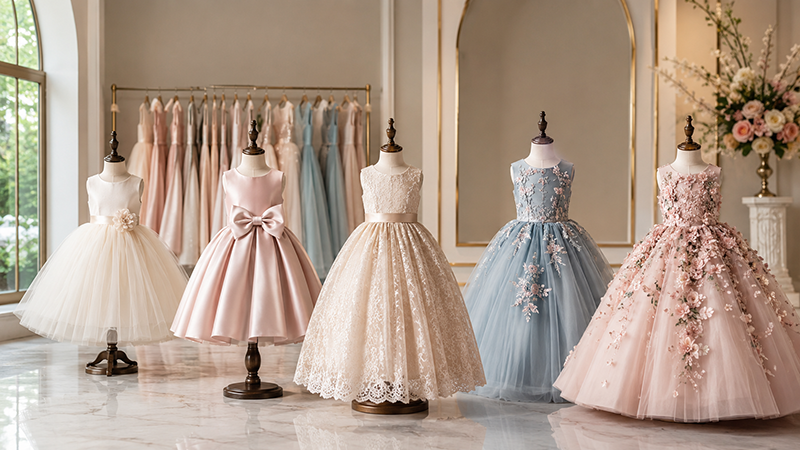
Flower girl dresses can look similar in product photos but have very different prices. The difference is not always caused by branding. Fabric quality, skirt construction, decorative workmanship, sizing accuracy and order requirements can all affect the final flower girl dress cost.
For wholesale buyers, choosing the lowest quotation does not always create the best profit. A slightly higher-cost dress may offer better presentation, fewer quality complaints and stronger repeat sales. Understanding what goes into the price makes it easier to compare suppliers and select products that match your market.
What Affects the Cost of a Flower Girl Dress?
The price of a flower girl dress is normally determined by several factors working together. A dress made with multiple layers of soft tulle, full lining, embroidery and hand-applied flowers requires more material and production time than a simple one-layer style.
The main factors include fabric quality, fabric consumption, skirt layers, decorative techniques, pattern development, order quantity and quality-control requirements. Custom colors, private labels and special packaging can also affect the quotation. Buyers should therefore compare the complete product specification rather than looking only at the unit price.
| Cost factor | Lower-cost option | Higher-cost option |
|---|---|---|
| Outer fabric | Basic polyester or stiff tulle | Soft tulle, quality satin or embroidered lace |
| Skirt construction | One or two layers | Multiple tulle and support layers |
| Decoration | Printed or machine-applied details | Hand-applied pearls, flowers or embroidery |
| Design | Existing factory style | New pattern or custom development |
| Order | Standard color and larger quantity | Small quantity or custom color |
| Inspection | Basic visual check | Measurement, workmanship and final inspection |
1. Fabric Quality and Skirt Construction
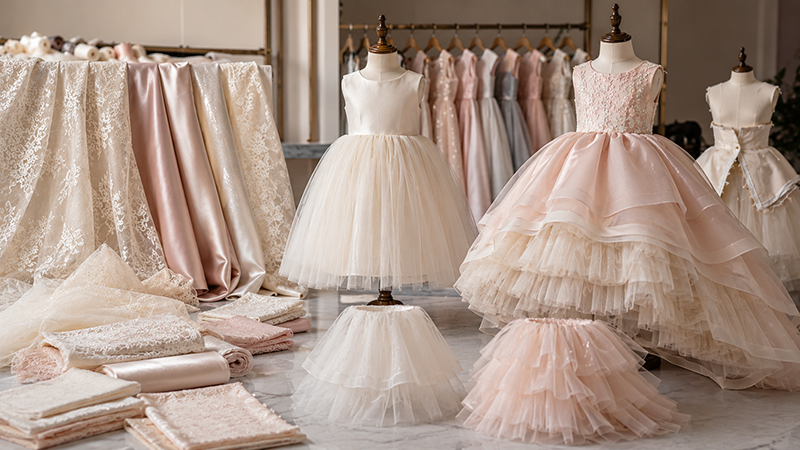
Fabric is one of the largest components of flower girl dress pricing. Tulle, satin, chiffon, lace and organza are available in different qualities, weights and finishes. Two dresses may both be described as tulle dresses, but one may use soft, fine tulle while the other uses a stiffer material that is less comfortable for children.
The lining is equally important because it sits directly against the skin. Soft lining, covered seams and suitable fabric thickness can improve comfort and make the dress feel more valuable. Buyers comparing wholesale flower girl dresses should request fabric swatches to evaluate softness, transparency, color and texture.
Fabric consumption also affects the price. A full princess skirt normally contains several outer tulle layers, a support layer and a soft lining. Every additional layer increases material use, cutting time and sewing work, while trains, tiered ruffles and asymmetrical hems require more careful cutting and alignment.
From our factory experience: tulle dresses should be measured again after steaming. Different layers may settle slightly after heating and hanging, particularly on full-length and high-low designs. Rechecking the length before packing helps reduce uneven hems and size inconsistencies.
2. Decorative Workmanship
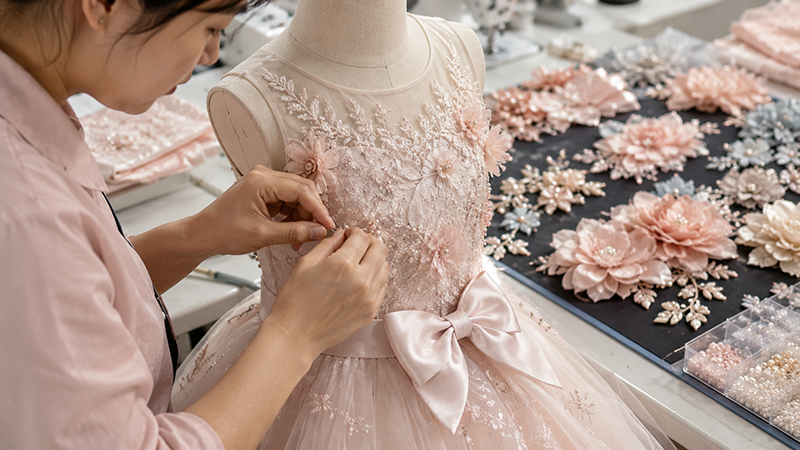
Lace, embroidery and handmade decorations can significantly change the price of a flower girl dress. Machine-produced glitter tulle may add only a small amount, while individually attached pearls, sequins, bows and 3D flowers require additional labor.
Decoration placement also matters. A lower-cost dress may use fewer appliqués or place them only on the front, while a premium version may continue the design around the bodice, sleeves and back. These details must also be attached securely to reduce the risk of loose flowers, pearls or sequins after transportation and fitting.
More decoration does not automatically mean better value. For some markets, one well-constructed oversized bow can create more visual impact than numerous small embellishments. Buyers should choose details according to their target price range and customer preferences.
3.Pattern Development and Sizing
A successful flower girl dress needs more than an attractive sketch. The factory must develop the pattern, select suitable materials and produce a sample. The neckline, waist position, bodice length, skirt volume and decoration placement may require adjustments before bulk production.
Children’s proportions change across age groups, so an adult dress pattern cannot simply be reduced. Shoulder width, armhole depth, waist position and dress length must be developed according to the intended sizes. A wider size range may therefore require additional pattern grading and measurement checks.
A completely custom design normally costs more than an existing style. However, an experienced OEM/ODM children’s clothing manufacturer can develop several variations from one approved base pattern. Changing the sleeve, color, fabric or decoration helps buyers create a coordinated collection without developing every style from the beginning.
Before approval, buyers should confirm the girls’ dress size guide, measurement method and acceptable tolerance. It is also important to clarify whether the chart shows body measurements or finished garment measurements.
4. Order Quantity and Customization
The same flower girl dress may have different prices depending on the order quantity. Fabric purchasing, pattern preparation, cutting and production setup create fixed costs. When these costs are divided across a larger order, the unit price generally becomes more efficient.
Small custom orders may cost more because the factory needs to source special fabric, match a custom color or produce limited quantities of private labels. Unusual size ratios, special packaging and rush production can also affect the quotation.
For new markets, buyers can test a focused assortment for 30–60 days and reorder the strongest designs. This normally provides more useful sales information than purchasing very small quantities of too many styles.
| Order requirement | Possible price effect | Buyer recommendation |
|---|---|---|
| Existing style and color | Lower development cost | Suitable for testing demand |
| Custom color | Fabric or dyeing MOQ | Approve a lab dip first |
| New design | Pattern and sample cost | Finalize specifications before sampling |
| Small order | Higher unit cost | Limit the number of colors |
| Private labels | Extra setup and materials | Combine labels across several styles |
| Rush order | Priority production cost | Order before the wedding season |
For new markets, buyers can begin with a focused assortment and reorder the strongest styles after 30–60 days of sales testing. This usually provides better information than purchasing very small quantities of too many designs.
5. Quality Control and Packaging
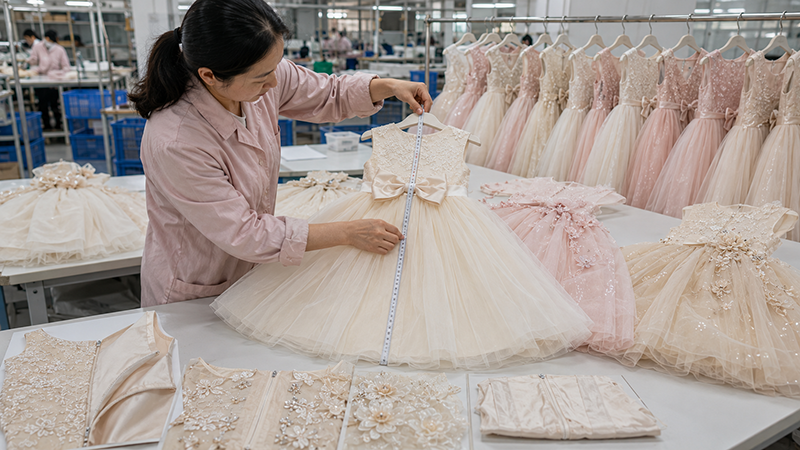
Quality control adds to the cost even though it may not be visible in product photos. Finished dresses should be checked for measurements, sewing quality, stains, loose decorations, zipper function and uneven skirt layers. Thread trimming, steaming and shaping are also necessary before packing.
Labels can create additional requirements in different markets. For example, the U.S. Federal Trade Commission provides guidance on fiber-content disclosure and garment care instructions. Buyers selling in the United States should review the relevant FTC textile labeling requirements before confirming production.
Packaging also affects the condition of the dresses after shipping. Full tulle or satin skirts packed into bags that are too small may arrive heavily crushed. Suitable folding methods, protective layers and correctly sized cartons help maintain the shape during international transportation.
Buyers can review a supplier’s factory and quality-control process to understand how inspection and packing are managed before placing a bulk order.
6. How to Compare Flower Girl Dress Quotations
A quotation cannot be evaluated accurately without a clear product specification. One supplier may quote a dress with two layers of basic tulle, while another prices a similar-looking design with four layers, soft lining and hand-sewn appliqués. Comparing only the final unit price would not provide a fair result.
Buyers should ask each supplier to confirm the fabric composition, number of skirt and lining layers, decoration method, size range, measurement tolerance, packaging and inspection standard. It is also important to check whether sample charges, custom labels and export cartons are included in the quotation.
When possible, compare physical samples under the same lighting. Examine both the inside and outside of each dress, paying attention to the seams, lining, zipper, embellishments and hemline. Buyers can also review how to avoid quality problems when sourcing girls’ dresses before approving a sample or placing a bulk order.
A higher price does not automatically guarantee better quality. Some price differences may come from branding, distribution costs or inefficient sourcing rather than improvements in fabric, construction or quality control.
Buyers should therefore focus on measurable differences such as fabric softness, skirt volume, lining coverage, stitching, decoration attachment and sizing consistency. The best choice is not always the most expensive dress, but the one that provides suitable quality for the target market. An approved sample and written product specification remain the most reliable basis for deciding whether a higher quotation is justified.
7. How Wholesale Buyers Can Control Costs
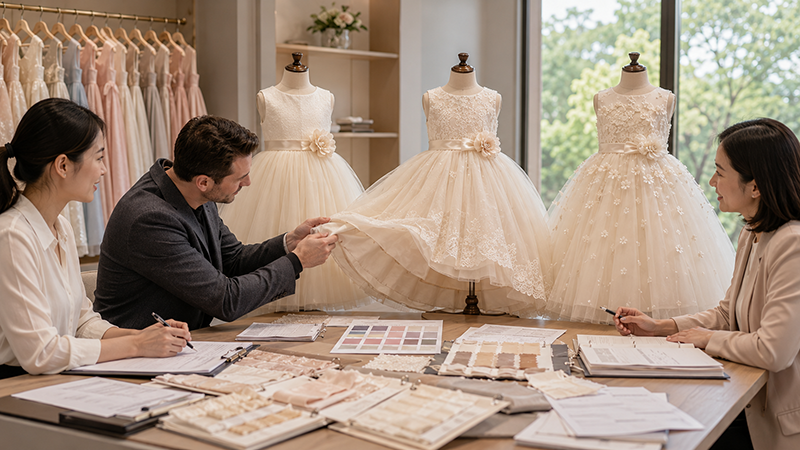
Controlling cost does not have to mean choosing the cheapest materials. A better strategy is to simplify low-impact details while protecting the features that influence fit, comfort and product presentation.
From our production experience: buyers often achieve better results when they identify two or three priorities before sampling. For example, they may require soft lining, a fuller skirt and securely attached pearls while keeping the packaging simple. This allows the factory to use the budget where customers are most likely to notice it.
Buyers can also use an existing base pattern, reduce the number of initial colors and select one statement detail instead of several. A balanced girls’ dress collection may include entry-level tulle dresses, mid-range satin or bow styles and a smaller selection of premium embroidered designs.
Frequently Asked Questions
Why are flower girl dresses more expensive than regular dresses?
They often use more fabric, additional skirt layers and decorative workmanship. They may also require more inspection, steaming and protective packaging.
What has the greatest effect on flower girl dress cost?
Fabric consumption and production labor usually have the greatest influence. Full skirts, embroidery and handmade decorations can increase both.
Are handmade flower girl dresses always better?
Not necessarily. Final quality still depends on the materials, construction and inspection, so buyers should evaluate an actual sample.
How can buyers reduce custom dress costs?
Use an existing base pattern, limit custom colors and simplify low-impact decorations. Combining labels and packaging across several styles may also reduce setup costs.
Why does a small order cost more per dress?
Material sourcing and production setup are divided across fewer garments. Custom fabrics and accessories may also have minimum order requirements.
What should buyers check before approving a sample?
Check the fabric, lining, measurements, zipper, seams, skirt balance and decoration attachment. Compare the sample with the confirmed specification before bulk production.
Conclusion
Some flower girl dresses cost more because they use better materials, more fabric, additional skirt layers and more complex workmanship. Pattern development, customization, sizing, inspection and packaging also influence the final quotation.
For wholesale buyers, the goal is not simply to find the lowest flower girl dress price. It is to understand which features improve comfort, presentation and retail performance. A detailed specification and approved sample make it much easier to compare suppliers fairly and avoid hidden quality costs.
Looking for Wholesale Flower Girl Dresses?
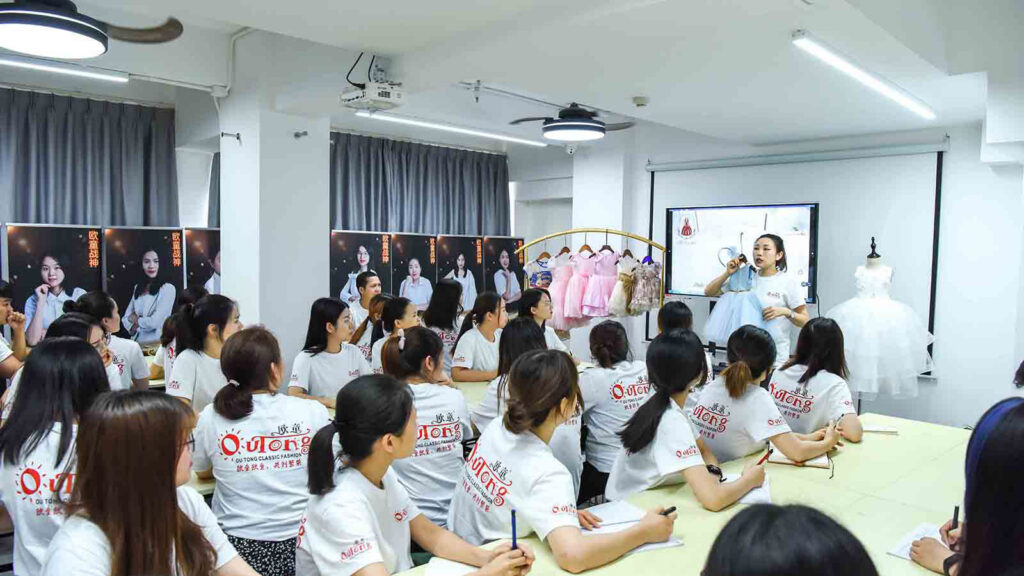
With more than 24 years of manufacturing experience, Outong Fashion supports wholesalers, retailers and brands with existing collections and custom flower girl dress development. We provide OEM/ODM services, custom colors, private labels, packaging and quality control.
Contact our team to request the latest catalog, wholesale pricing or sample information.