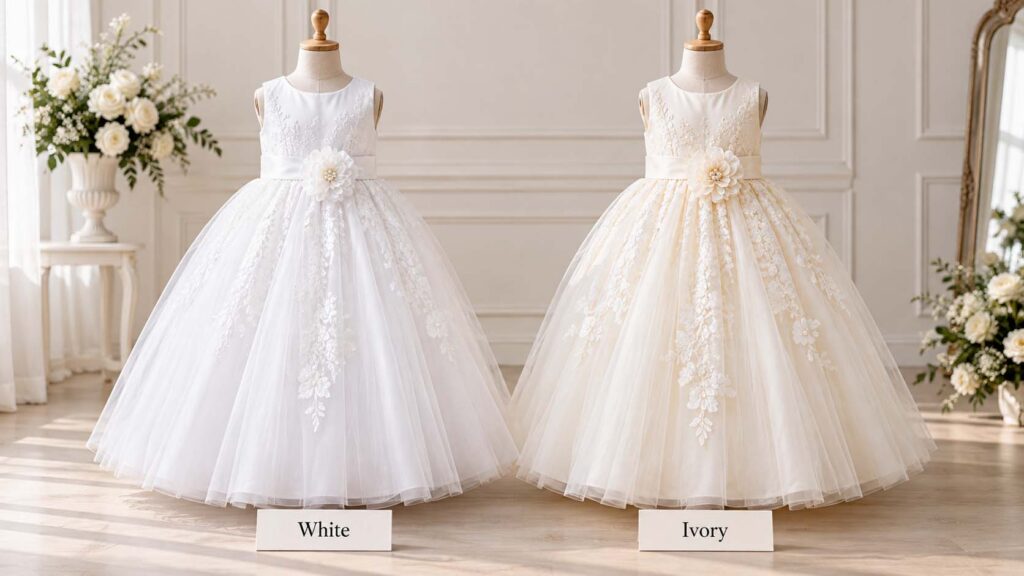
Put a white flower girl dress next to an ivory one, and the difference is usually easy to see. White looks brighter and cleaner, while ivory has a softer, warmer tone. Once the dresses are separated, however, the distinction can become much less obvious, especially in photographs.
That is because color is only part of what you are seeing. Satin reflects light differently from tulle, lace can soften the shade underneath it, and even the lining can change the overall appearance of a dress. So when choosing between ivory and white flower girl dresses, it helps to look beyond the color name and consider the whole garment.
What’s the Difference Between Ivory and White Flower Girl Dresses?
Pure white is the brighter of the two. It has little noticeable warmth and tends to create a fresh, crisp look, which is one reason white flower girl dresses remain such a familiar choice for weddings.
Ivory is still very close to white, but it carries a subtle creamy or warm undertone. It usually feels softer beside pure white, although the difference can range from barely noticeable to quite clear depending on the fabric.
| Feature | White | Ivory |
|---|---|---|
| Tone | Bright, clean white | Warm, creamy white |
| Overall Look | Crisp and fresh | Soft and warm |
| Common Pairing | White bridal gowns | Ivory or warm-white gowns |
| Fabric Influence | Often appears brighter | Warmth varies by fabric |
This is something we see regularly when developing girls’ dresses and flower girl styles at Outong. We rarely look at the shade in isolation. The dress design and fabric usually need to be considered together. A white satin bodice can look noticeably brighter than a white layered-tulle skirt, while ivory lace placed over a lining may create yet another variation of the same shade.
The finished garment tells you much more than a digital color swatch alone.
Should a Flower Girl Dress Be White or Ivory?
There is no rule that says a flower girl has to wear pure white.
In the flower girl dress orders we produce, customers request both white and ivory, although white is the more common choice in our own orders. That is simply what we see in our production rather than a rule that applies to every wedding or market.
Ivory often makes sense when the bridal gown has a warmer undertone, when the wedding palette includes cream and other warm neutrals, or when lace and softer fabrics are a major part of the look. White may suit a brighter bridal gown or a cleaner, more contemporary palette.
Modern flower girl styling allows plenty of flexibility as well. As explained in Brides’ guide to flower girl etiquette, the role has traditions behind it, but couples have room to decide how the flower girl fits into their ceremony.
So rather than asking which color is universally better, it is more useful to ask which one works with this particular dress, bride, and wedding.
If you are considering shades outside the traditional white family, our guide to whether a flower girl dress can be a different color looks more closely at alternative colors and how they can work within a wedding palette.
Should the Flower Girl Dress Match the Bride’s Dress?
It can, but it does not need to be an exact match.
If the bride is wearing a bright white gown, a white flower girl dress is an easy way to create a coordinated look. Even then, the two dresses may not appear identical. A bridal gown covered in lace can read much softer than a satin flower girl dress despite both fabrics being described as white.
The same principle applies to ivory. If the bride wears ivory, choosing an ivory flower girl dress is a natural option, but soft white or off-white may also sit comfortably within the same palette.
This is where trying to match a color name too precisely can become misleading. Two garments can both be labelled “ivory” and still look slightly different because of their fabric, lining, texture and finish.
The Knot’s flower girl dress guide also approaches the flower girl’s outfit as part of the wider wedding look rather than something that has to copy the bridal gown exactly.
In most cases, coordination matters more than perfect duplication.
How Fabric Changes the Look of White and Ivory
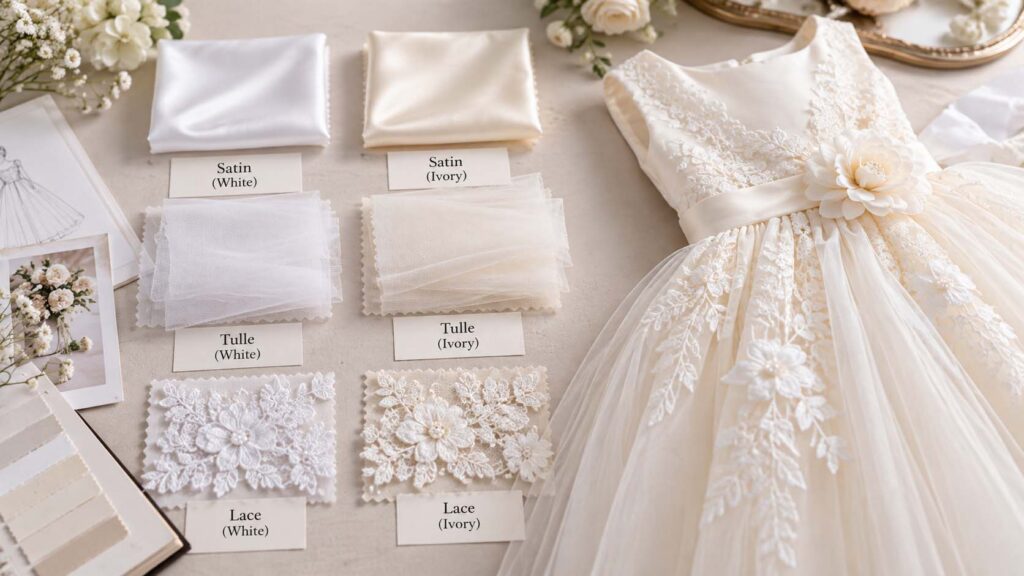
Fabric can change the way white and ivory look more than many buyers expect. We notice this especially when comparing a fabric swatch with a finished flower girl dress. Satin reflects more light, so white satin often looks clean and bright, while ivory satin tends to show its warmer tone more clearly.
Tulle and lace are less straightforward. Because tulle is sheer, the final color depends on the number of layers and, just as importantly, the lining underneath. Lace can shift the look again when it is placed over satin or lining. This is why two white or ivory flower girl dresses can look slightly different even when the fabrics were ordered under the same color name.
Organza has a similar issue because its transparency and sheen react strongly to light. In practice, we prefer to look at these materials together on the finished dress rather than judge the shade from individual swatches. If you are deciding between fabrics for a collection, our satin vs tulle flower girl dress guide explains the differences in appearance, structure and use.
Why We Don’t Recommend Choosing Ivory From a Photo Alone
This is one point we regularly discuss with buyers.
An ivory dress photographed beside a window may appear very pale. The same dress under warm indoor lighting can look noticeably creamier. Camera settings, editing and even the screen used to view the image can change it again.
For that reason, when the exact shade matters, we prefer to confirm a finished sample before moving into bulk production. This allows the buyer to see the satin, tulle, lace, lining and embellishments working together on the actual garment.
For a private-label or wholesale collection, that is much more reliable than approving “ivory” based only on a photograph.
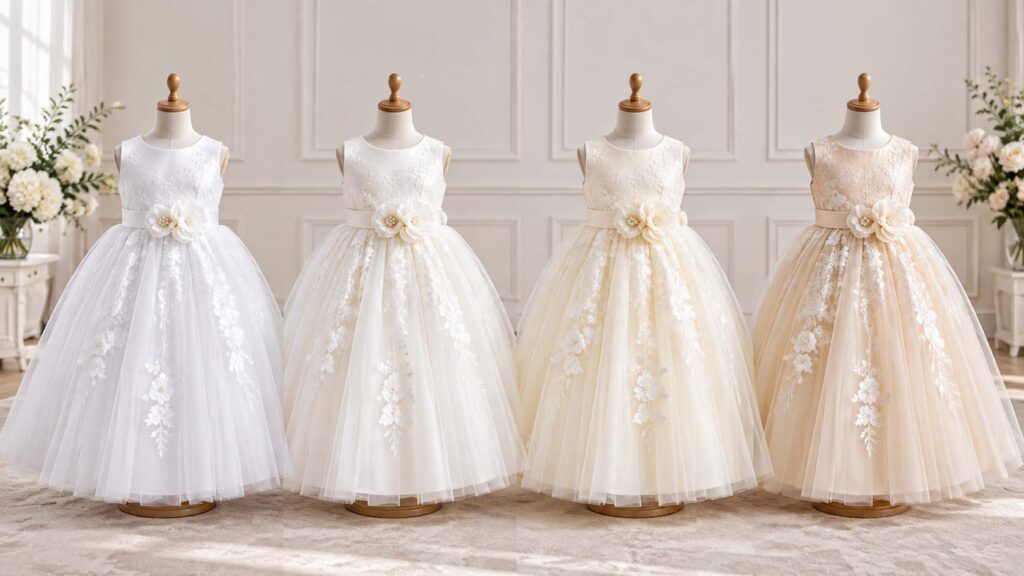
White, Off-White, Ivory and Champagne Aren’t the Same
Once you move away from pure white, color names can become confusing. Soft white, off-white, ivory and champagne are sometimes used loosely in product descriptions, even though they can look quite different when placed side by side.
| Shade | What It Usually Looks Like |
|---|---|
| Pure White | Brightest and cleanest white |
| Soft White / Off-White | Softer and less stark than pure white |
| Ivory | White with a warm,creamy undertone |
| Champagne | Noticeably warmer, often with beige or subtle golden tones |
The important word here is usually.
These names are useful for describing a color family, but they are not enough to guarantee an exact match between different fabrics or suppliers. One mill’s ivory satin may not be identical to another supplier’s ivory lace.
That becomes particularly important in flower girl dresses because one style can contain several materials. A dress might have a satin bodice, tulle skirt, lace appliqués and lining, all intended to be ivory. What matters in production is whether those components look right together, not whether each fabric was given the same color name.
For retailers placing repeat orders, this distinction matters even more because the approved garment provides a clearer color reference than the word “ivory” alone.
Which Shade Works With Different Wedding Styles?
Neither white nor ivory belongs exclusively to one type of wedding. Still, the surroundings can affect how each shade feels.
| Wedding Style | Common Color Direction |
|---|---|
| Classic or Church | White or lvory |
| Garden | Ivory or Soft White |
| Modern | Crisp White |
| Vintage or Rustic | Ivory or Champagne |
| Beach | Soft White or Light lvory |
A modern ceremony with a bright bridal gown and clean floral palette may suit crisp white flower girl dresses beautifully. In a garden setting filled with cream flowers, greenery and warm natural tones, ivory can blend more softly into the surroundings.
These are styling ideas rather than dress-code rules. Looking at the gown, flowers, venue and fabrics together will usually give a better answer than choosing a shade based on the wedding label alone.
Our wedding and flower girl solutions show how girls’ dresses and children’s formalwear can be developed for different wedding settings and product requirements.
What Retailers and Brands Should Check Before Ordering
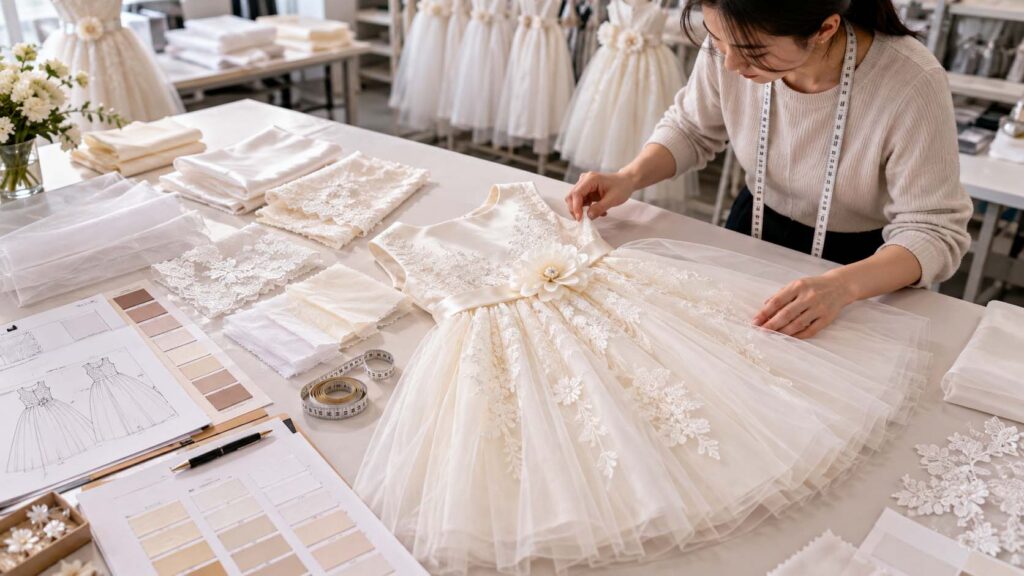
For retailers and bridal stores, the difference between white and ivory becomes more important when the same dress is being ordered in quantity. A small color variation that is hardly noticeable in one piece can become much more obvious when several dresses are displayed together or when a style is reordered later.
From a production point of view, we recommend checking the finished dress rather than one fabric swatch alone. Many flower girl dresses combine satin, tulle, lace and lining, and each material can affect the final shade. We have seen cases where the outer tulle looks very close to the requested ivory, but the lining underneath makes the finished skirt appear warmer once all the layers are assembled.
This is why we prefer buyers to approve a complete sample before bulk production when color matching matters. It gives them a chance to check the actual shade, fabric layering and embellishments together instead of trying to judge each component separately.
For assortment planning, both ivory and white flower girl dresses have a place in the market. In our own orders, white is requested more often, although we would not use that alone to decide what a retailer should stock. The existing bridal range, target customers and styles in the collection are more useful guides. If both shades are offered, keeping the approved sample and fabric references also makes repeat production easier to control.
Buyers planning a new collection can browse the girls’ clothing styles we manufacture to compare different formal dress directions before moving into sample development.
What We’ve Learned From Producing Flower Girl Dresses
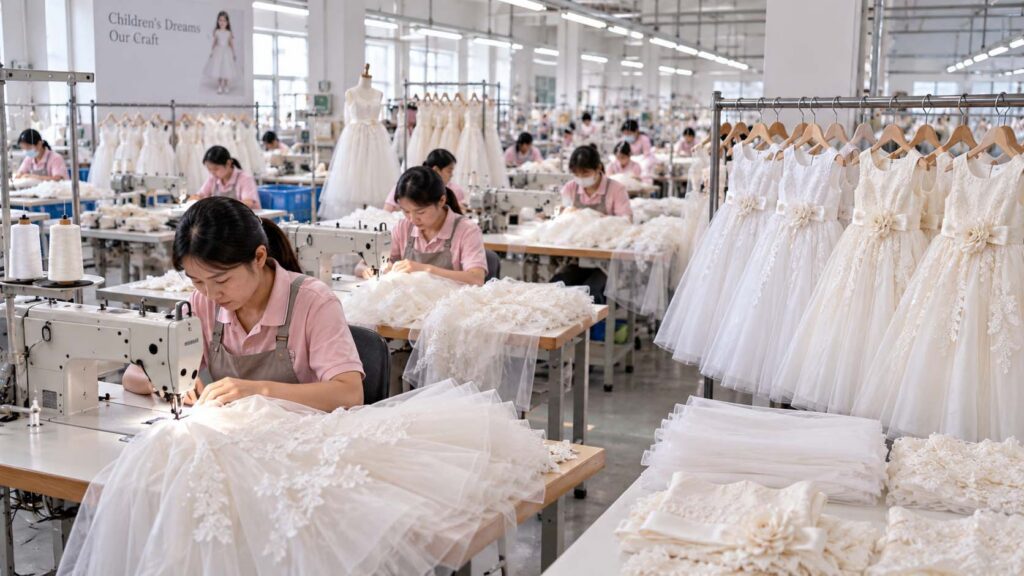
At Outong, we develop and manufacture flower girl dresses for wholesale and private-label buyers, from fabric selection and sampling through bulk production and quality checking. White and ivory are both regular colors in the styles we produce, but working with them is rarely as simple as choosing a shade from a color card.
One detail we pay particular attention to is how all the materials look after the dress is assembled. A flower girl dress may combine a satin bodice, several layers of tulle, lace appliqués and a separate lining. Each component can look right on its own but slightly different once they are placed together. With white and ivory dresses, even a small difference is easier to notice because the overall palette is so light.
This is why we treat color as part of the garment development process rather than a standalone specification. For buyers developing their own collection, you can learn more about Outong and our children’s clothing production or contact our team to discuss flower girl dress sampling and custom development.
FAQs About Ivory and White Flower Girl Dresses
Q1: Do Flower Girl Dresses Have to Be White?
No. White is traditional, but it is not compulsory. Ivory, champagne, blush and other colors can all work when they fit the wedding palette.
If you are considering something beyond white, choosing a shade that coordinates with the bridal gown and the rest of the ceremony is usually more useful than following a strict color rule.
Q2: Should a Flower Girl Dress Be White or Ivory?
Both are suitable. White gives the dress a brighter, crisper appearance, while ivory feels warmer and softer.
Look at the bridal gown, wedding colors, fabric and dress design together before deciding rather than choosing from the color name alone.
Q3: Can a Flower Girl Wear Ivory if the Bride Wears White?
Yes. The shades do not have to match exactly.
An ivory flower girl dress can still work with a white bridal gown when the overall palette feels coordinated. Different fabrics can also make two supposedly matching whites look slightly different anyway.
Q4: Is Ivory the Same as Off-White?
Not quite. Off-white is generally a softer version of white, while ivory usually has a more noticeable creamy or warm undertone.
In finished garments, however, the exact difference can vary with the fabric, lining and supplier.
Q5: Does the Flower Girl Dress Need to Match the Bride Exactly?
No. A coordinated look is usually enough.
Bridal gowns and flower girl dresses often use different fabrics, layers and finishes, so trying to create an exact color match is not always necessary. Looking at the finished garments together is more useful than relying only on the names of the colors.
Choosing the Right Ivory or White Flower Girl Dress
The simplest distinction is that white looks brighter and crisper, while ivory looks softer and warmer. What works best depends on the bridal gown, wedding palette, dress design and, importantly, the fabrics used to make the dress.
For retailers and brands, there is one additional step worth taking: when the shade really matters, look at the finished sample before approving bulk production. It gives a far more useful picture than a color name or product photograph alone.
If you are building a bridal or children’s formalwear collection, explore our girls’ and flower girl dress collection.
Contact our team to discuss sampling, wholesale orders and custom development.