When adding new kidswear styles, buyers often face a practical choice: order available stock for a faster launch, or invest in custom production for more control over the collection?
Ready stock works well for testing new styles, adding variety, and replenishing products quickly. Custom production offers more control over design, sizing, materials, and branding. For many retailers and wholesalers, the best sourcing strategy may actually involve both.
What Is Ready Stock Kidswear?
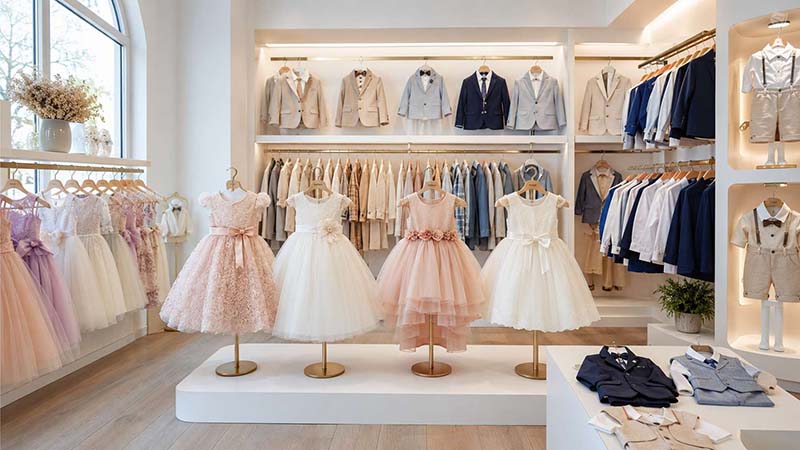
Ready stock kidswear refers to styles that a supplier already has available for wholesale orders. Buyers select from existing designs, colors, and size ranges instead of developing a new product from the beginning.
This makes ready stock particularly useful for boutiques, wholesalers, and retailers that want to test new products, expand their assortment, or replenish stock quickly.
The trade-off is flexibility. Because the styles have already been developed, major changes to fabrics, colors, construction, or sizing usually require custom production.
What Is Custom Kidswear?
Custom kidswear is developed according to a buyer’s specific product or brand requirements.
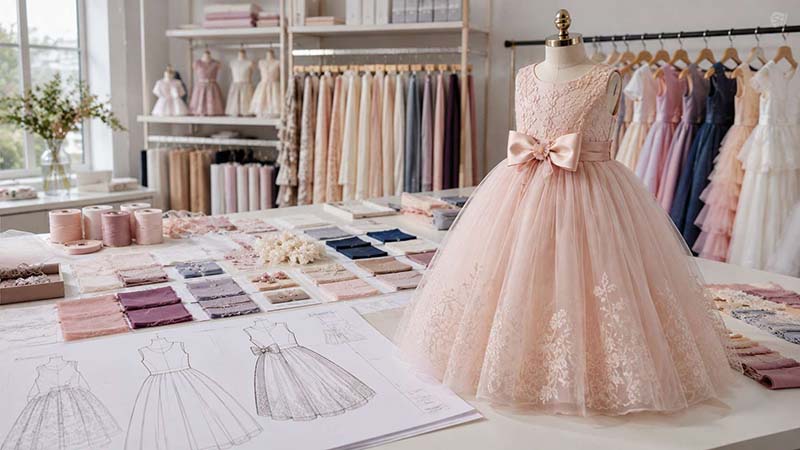
Depending on the manufacturer, OEM/ODM production may include changes to fabrics, colors, embroidery, prints, trims, sizing, labels, hangtags, and packaging. Buyers can modify an existing style or develop a new product based on their own designs. For children’s clothing, material selection may also need to consider recognized textile safety standards such as OEKO-TEX® STANDARD 100.
This makes custom production more suitable for established brands, importers, and chain retailers that want a distinctive collection rather than products that are already available to the wider market.
Ready Stock vs Custom Kidswear: Key Differences
The two sourcing models solve different purchasing needs.
| Factor | Ready Stock | Custom Kidswear |
|---|---|---|
| MOQ | Usually lower | Usually higher |
| Lead time | Shorter | Longer |
| Design flexibility | Limited | High |
| Product development | Minimal | Required |
| Private label options | Depends on style | More flexible |
| Market testing | Excellent | Less flexible |
| Brand differentiation | Moderate | Strong |
| Best for | Testing and fast replenishment | Exclusive and planned collections |
A boutique testing girls’ party dresses for a new season has very different needs from a children’s clothing brand developing an exclusive collection. The better sourcing model depends on what the order needs to achieve.
When Should You Choose Ready Stock?
Testing New Products
One of the biggest advantages of ready stock kidswear wholesale is the ability to test demand without committing to a large custom order.
For example, a retailer entering the girls’ occasionwear market may not yet know whether customers prefer knee-length party dresses, formal gowns, flower girl dresses, or simpler styles.
Starting with ready stock allows the retailer to compare actual sales before deciding where to invest more heavily, which can also help businesses manage inventory risk more carefully.
Building a Wider Product Assortment
For boutiques and wholesalers, a wider assortment can help serve customers with different style, color, and occasion needs.
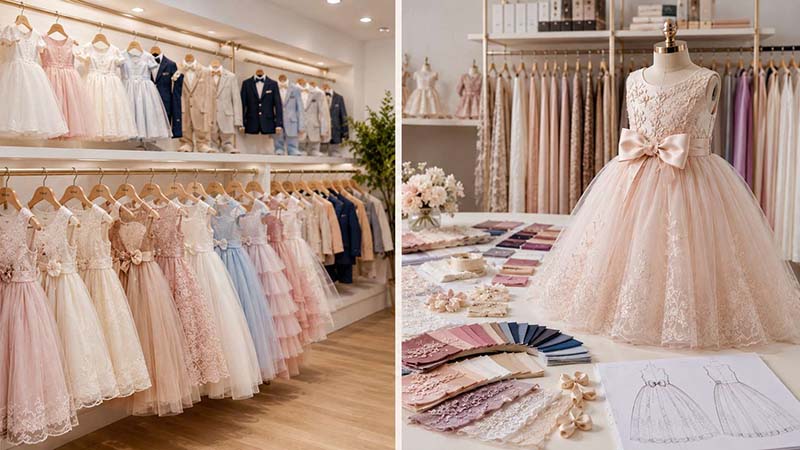
Ready stock makes it easier to carry more styles, colors, and product categories within the same purchasing budget, rather than committing a large quantity to only a few designs. This is especially useful for children’s formalwear, where demand may include party dresses, flower girl dresses, First Communion styles, Baptism outfits, and boys’ formalwear.
Fast Replenishment
Ready stock can also help when a product sells faster than expected or a retailer needs additional styles for an upcoming season.
When inventory is available, ordering from a ready stock kidswear supplier is usually faster than starting another custom production cycle.
For seasonal businesses, that extra flexibility can make a meaningful difference.
When Is Custom Kidswear the Better Choice?
Building a Distinctive Brand
As a children’s clothing business grows, selling the same products available to many other stores can make differentiation difficult.
Working with a custom kidswear manufacturer allows buyers to create products around their own market positioning. This may include exclusive colors, specific fabrics, embroidery, silhouettes, trims, or coordinated collections.
Private labels, hangtags, and branded packaging can also be integrated into the production process, helping create a more consistent brand experience.
Developing Proven Best Sellers
Custom production becomes particularly useful when you already have reliable sales data.
Suppose a retailer knows that certain tulle party dresses, flower girl styles, or boys’ formalwear consistently perform well. Instead of continuing to test unrelated products, the business can develop its own version of those proven categories.
The higher investment in custom production becomes easier to justify when purchasing decisions are based on real customer demand.
Maintaining Consistency at Scale
Chain stores, importers, and larger wholesalers often need more control over measurements, fabric shades, construction, trims, labeling, and packaging.
OEM/ODM production makes it easier to define these specifications before bulk production and maintain consistency across larger orders.
Ready Stock vs Custom Kidswear MOQ
MOQ is an important difference between the two sourcing models.
Ready stock generally has a lower MOQ because the product has already been developed. Custom orders require additional work such as material sourcing, sampling, pattern adjustments, and production preparation.
At Outong, selected ready-stock kidswear starts from 30 pieces per design, while custom production starts from 240 pieces per design.
The lowest MOQ, however, is not always the best purchasing decision. Buyers should also consider expected sales, inventory turnover, and how long they are comfortable holding stock.
For a new product, a smaller ready-stock order may be safer. For a proven bestseller, a larger custom order may offer greater long-term value.
Can You Combine Ready Stock and Custom Production?
Yes. For many retailers and wholesalers, combining the two is more practical than choosing only one.
A simple sourcing strategy is:
Ready Stock → Test the Market → Identify Best Sellers → Custom Development
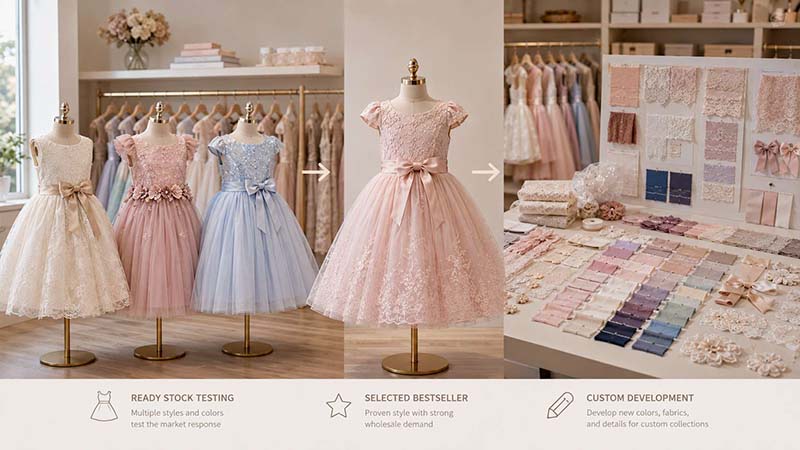
A retailer might begin with several ready-stock girls’ dresses in different colors, lengths, and silhouettes. After seeing which products sell consistently, the buyer can use that information to develop an exclusive version.
For example, a successful ready-stock party dress could later be customized with a different color palette, embroidery, size range, private label, or packaging.
This approach reduces guesswork. Ready stock provides flexibility for testing, while custom production is reserved for products with stronger sales potential.
Even established brands can use this model. Their core collection may be custom-made, while ready stock fills seasonal gaps or helps them respond quickly to new demand.
Which Option Fits Your Business?
There is no single sourcing model that works for every buyer.
| Business Type | Recommended Approach | Main Reason |
|---|---|---|
| Small boutique | Ready stock | Lower inventory commitment |
| New online retailer | Ready stock | Easier product testing |
| Wholesaler | Ready stock + custom | Variety plus differentiation |
| Established kidswear brand | Custom | Greater product control |
| Chain store | Custom or mixed | Consistency across larger orders |
| Seasonal retailer | Mixed | Flexible replenishment |
Your sourcing strategy can also change as your business grows. A retailer may begin with ready stock, move successful products into custom production, and continue using ready stock to test new categories.
What Should You Ask Your Kidswear Supplier?
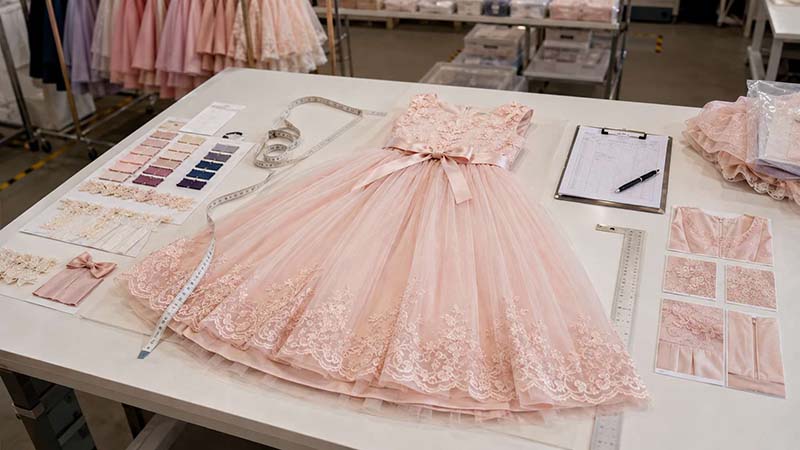
Before placing an order with a wholesale kidswear supplier, confirm the details that directly affect your purchasing plan:
- MOQ per style or color
- Available sizes and stock quantities
- Sample requirements
- Custom fabric and color options
- Private label and packaging services
- Production lead time
- Quality-control procedures
- Reorder availability
For ready stock, actual inventory availability is especially important. For custom production, make sure the supplier can maintain approved measurements, materials, colors, and workmanship from sample to bulk order.
FAQ
Is ready stock kidswear suitable for small retailers?
Yes. Ready stock can help smaller retailers test more styles with a lower inventory commitment. It is particularly useful when the business is still learning which products, colors, and sizes sell best.
What is the MOQ for custom kidswear?
MOQ varies depending on the manufacturer, product, fabric, and customization requirements. At Outong, custom production starts from 240 pieces per design.
Can I add my own label to ready-stock kidswear?
It depends on the style and supplier. Some ready-stock products may support private labeling, while others have limited customization options. Confirm this before ordering.
Should a kidswear brand choose ready stock or OEM production?
Established brands often use OEM/ODM production for their core collections because it provides greater control over design and branding. Ready stock can still be useful for testing new products, filling assortment gaps, or responding to seasonal demand.
Ready Stock or Custom Kidswear: Which Is Better?
Ready stock is a practical choice when you need faster ordering, more variety, and lower inventory commitment. Custom kidswear is better when you need exclusive designs, stronger branding, and greater control over your collection.
For many retailers and wholesalers, a mixed approach works best: use ready stock to test what sells, then develop proven styles through custom production.
Looking for Ready Stock or Custom Kidswear?
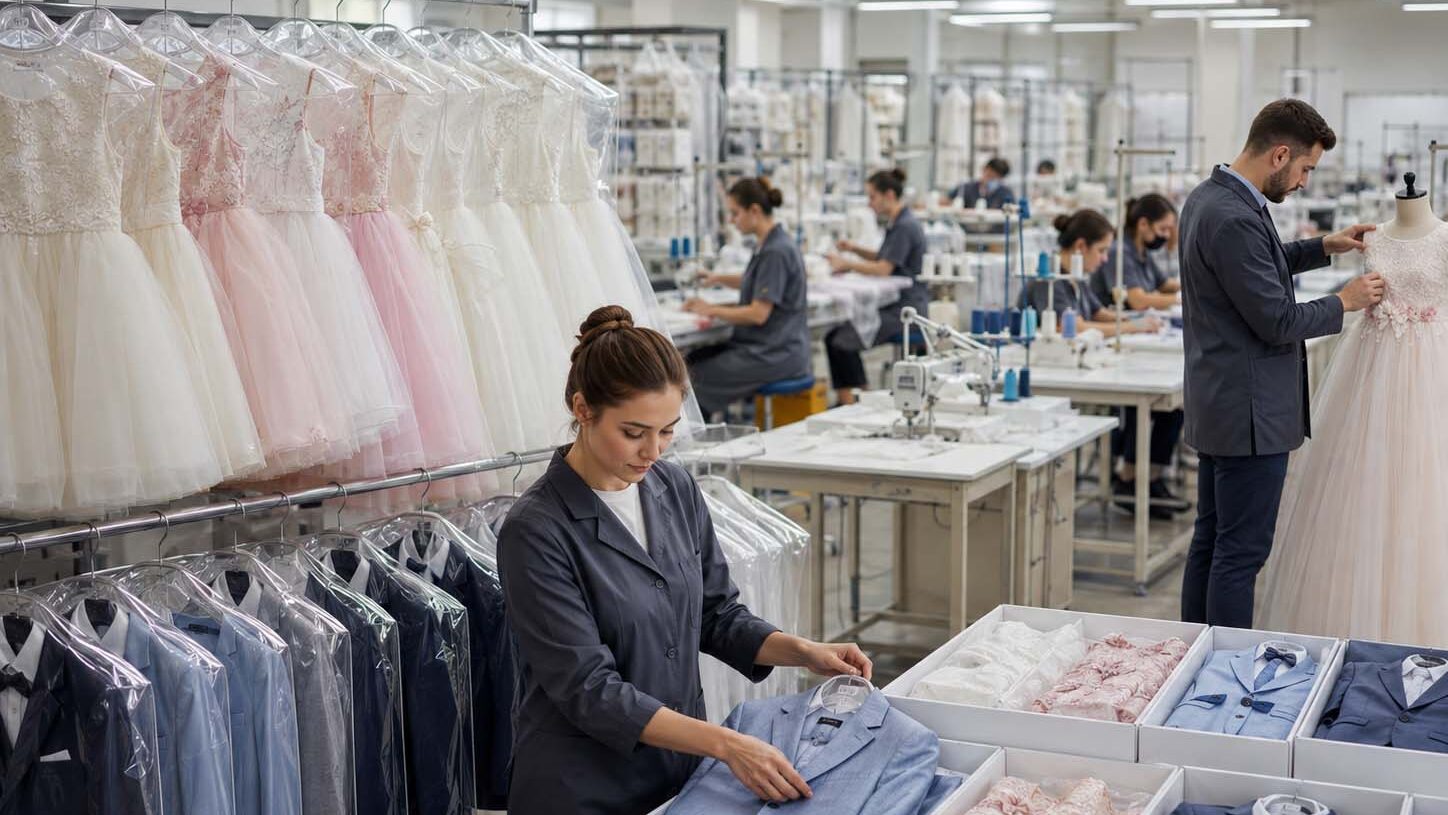
Outong supports retailers, wholesalers, and brands with both sourcing options. Selected ready-stock styles start from 30 pieces per design, while custom OEM/ODM production starts from 240 pieces per design.
Explore our kidswear collections or contact us to discuss the right sourcing option for your business.